by Jack Norris, registered dietitian and executive director of Vegan Outreach
Contents
- Nutrients in a Wide Range of Plant Foods
- Nutrients in a Select Group of Plant Foods
- Nutrients Most Easily Obtained from Supplements
- Other Versions of this Article
- References
For optimal health, current and aspiring vegans should be well-informed about nutrition. While vegans have lower rates of type 2 diabetes (1, 2), high blood pressure (3, 4), cancer (5, 6), and high cholesterol (7), several nutrients warrant attention. This article provides the essential information you need to know. For those who desire it, we link to additional information for each nutrient.
Nutrients in a Wide Range of Plant Foods
Protein and iron are commonly thought to be difficult to obtain on a vegan diet but they’re actually easily obtained for most people.
Protein
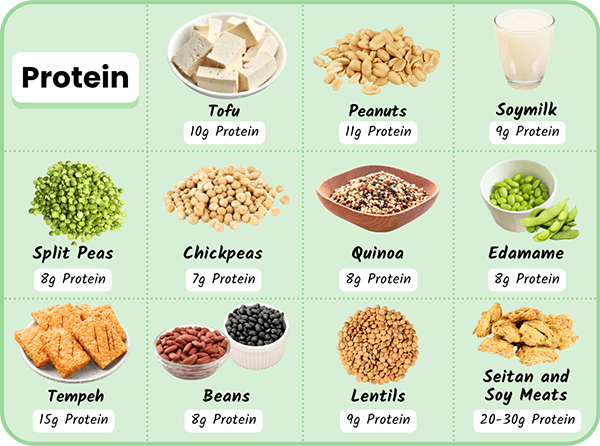
“Where do you get your protein?” is typically the first question vegans are asked. It can be hard to answer because almost all plant foods contain protein, so vegans are getting protein from everything they eat.
We generally encourage vegans to eat 1 g of protein for every kg of body weight per day. For a 150 lb person, that translates to 68 g of protein. Athletes might need more and should experiment with varying amounts to find the best results; see Sports Nutrition for more information about vegan athletes’ protein needs. There’s evidence that as people age, they need a higher percentage of their calories to be protein; people over 60 should focus on making high-protein foods a large part of their meals. And vegans who aren’t eating enough calories to maintain their weight should make an effort to include a higher percentage of protein.
Anyone who’s regularly been eating meat and cheese is used to high amounts of protein and if you’re craving animal products or feeling fatigued on a vegan diet, adding more protein is often the solution.
Common high-protein vegan foods:
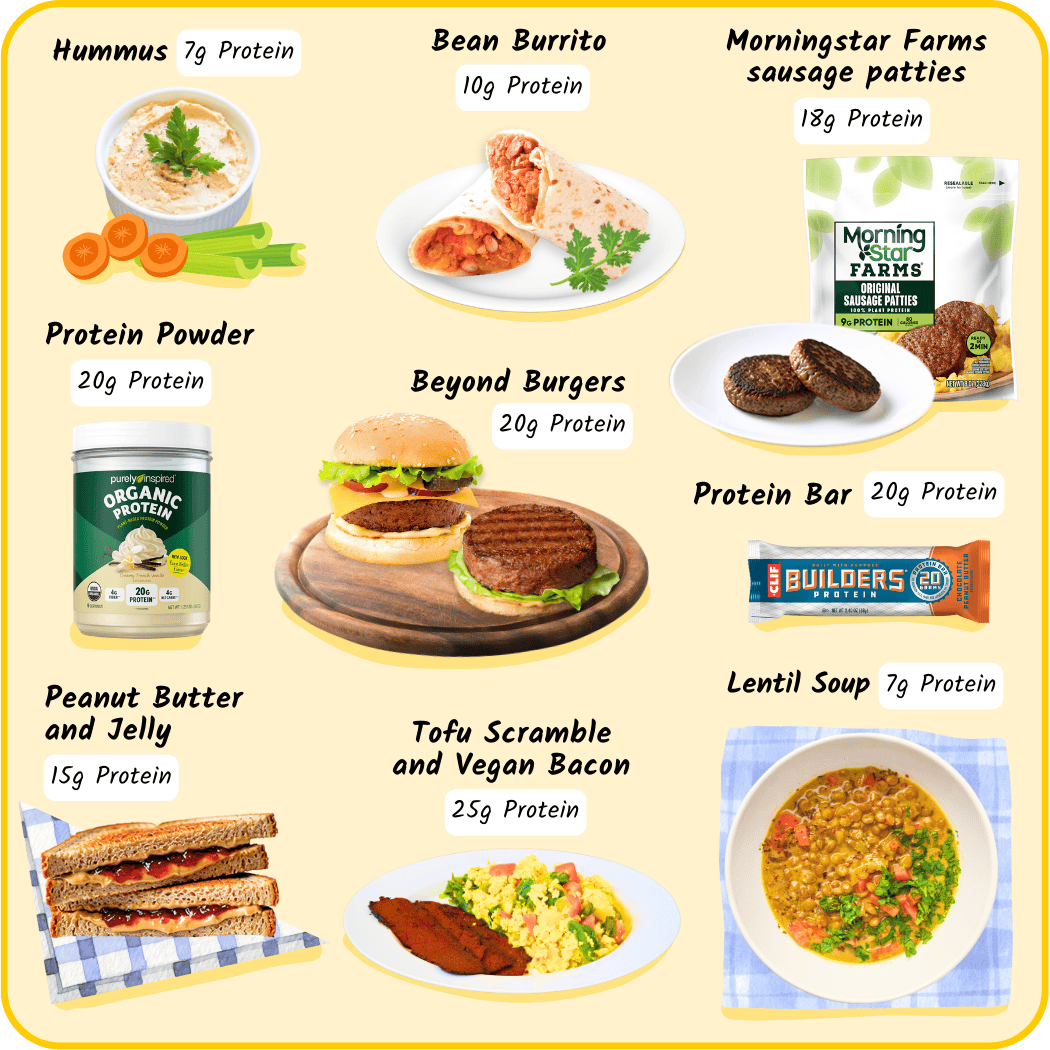
Common high-protein entrees and snacks:
For a thorough discussion about plant vs. animal protein, see Protein.
Soy
Speaking of protein, soyfoods have traditionally been a staple of many vegan diets due to their high protein content. Myths abound that soy is harmful and that has made some people shy away, but there’s plenty of scientific evidence that two servings of soyfoods per day is perfectly safe. Higher amounts are probably also safe but they haven’t been studied as thoroughly. As a vegan dietitian, athlete, and someone familiar with the scientific research on soy, I happily eat as much soy as I desire!
The most robust area of research on soy has been with respect to breast cancer and the overwhelming evidence is that soy can reduce the risk of breast cancer. There’s also evidence to suggest that soy can reduce the risk of prostate cancer and heart disease (by lowering LDL cholesterol). You can read more in our article Soy: Main Controversies.
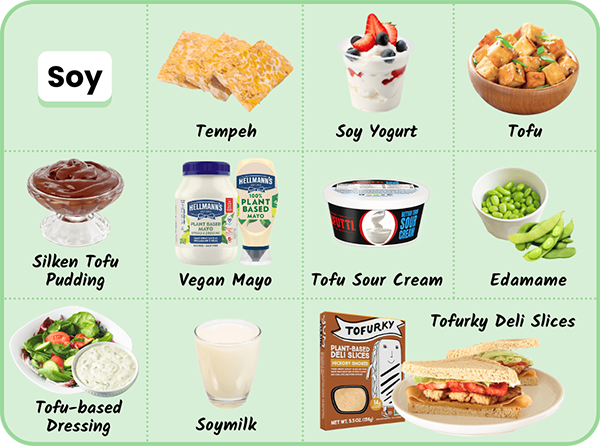
Tofu is an extremely versatile soyfood that has been eaten in some Asian cultures for hundreds of years. You can fry or bake it and add it to just about any savory dish. You can also freeze and then thaw it to give it a chewy texture. Tofu doesn’t have much taste on its own, but it takes on the flavors of the foods it’s mixed with.
Tofu is normally made with calcium salts and is therefore a rich source of calcium for vegans (check the packaging for “calcium” in the ingredients).
Another type of tofu, silken tofu, has a smooth texture and is used for making pudding, mousse, and cream-based pies. Silken tofu is often found in the baking or Asian sections of the grocery store.
While most vegans eat soyfoods, you don’t need to in order to be a vegan as there are plenty of other high-protein foods. But unless you have a specific allergy to soy, there’s no reason why you can’t enjoy it just like millions of other people throughout the world, vegans and meat-eaters alike.
Iron
People often associate iron with red meat, so you might be surprised to know that iron is plentiful in plant foods and vegans often have higher iron intakes than meat-eaters. Obtaining enough iron from vegan foods is easy if you eat legumes (beans, peas, and lentils) and dark leafy green vegetables (such as spinach and collards). Iron is found in a range of other plant foods and many countries have foods fortified with iron. Blackstrap molasses is a type of molasses that’s high in iron.
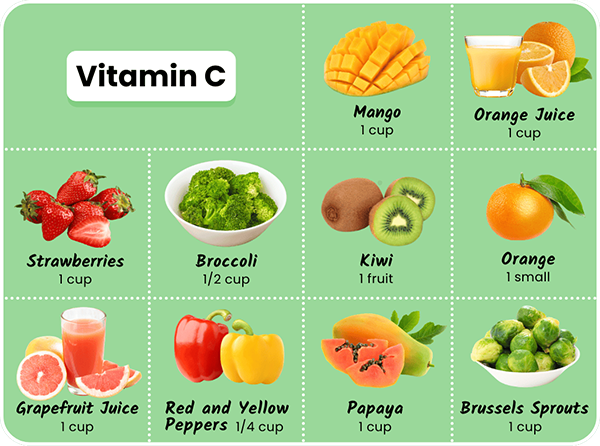
What’s more important for meeting iron needs as a vegan is to include foods high in vitamin C with meals which increases iron absorption from other foods at that meal. For example, oatmeal with orange juice at breakfast provides iron from the oats and vitamin C from the juice. The image below shows foods high in vitamin C and what amount should be eaten to significantly increase iron absorption.
Most vegans don’t need to be too concerned about iron unless they have a history of iron deficiency. One exception is long-distance runners who menstruate, as they have a high amount of red blood cell loss. If you’re prone to iron deficiency, eat plenty of meals containing foods high in iron and vitamin C and avoid coffee and tea (which decrease iron absorption) within an hour of such meals.
Nutrients in a Select Group of Plant Foods
Vegans should pay attention to how they’re obtaining calcium, vitamin A, and omega-3s. Below, we’ll help you find good sources of these nutrients!
Calcium
Vegan adults should eat 3 servings of good sources of calcium per day while teenagers should eat 4 servings. The image below shows good sources of calcium that are readily available in the United States. The image lists the amount of each food that qualifies as one serving.
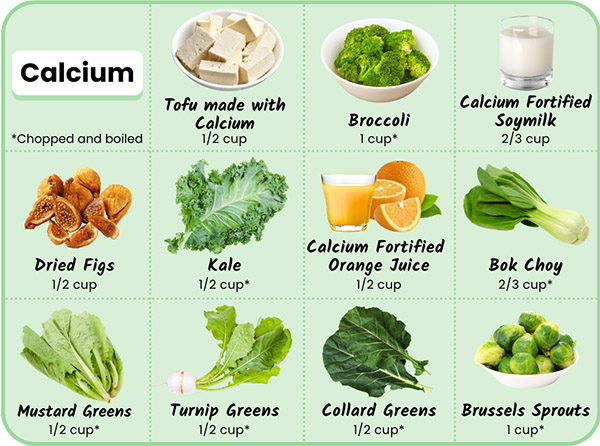
Luckily, most plant-based milks are fortified with calcium. And one of my favorite foods for obtaining calcium is tofu made with calcium salts, which is high in calcium and protein, both of which are good for bones. If you find it inconvenient to eat foods high in calcium each day, a calcium supplement of about 500 mg per day is another option.
Resistance exercise twice a week, involving lifting moderate weights, is possibly the most reliable way for people to increase the strength of their bones. We encourage everyone to follow such a program. Talk to your health professional about what program is right for you.
Vitamin A
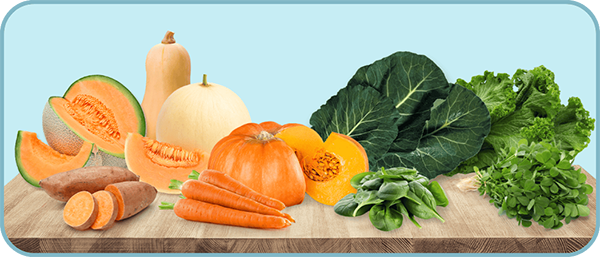
Vitamin A is important for night vision and bone density. Vegans should eat at least two servings of good sources daily. Good sources are vegetables and fruits whose edible flesh is orange: carrots and other root vegetables (1/2 cup), squash (1/2 cup), and melons (2 cups). The orange color indicates beta-carotene which our bodies can turn into vitamin A. Dark leafy green vegetables (1 cup cooked) are also high in vitamin A. Foods with yellow flesh are generally not good sources of vitamin A.
Pumpkin Mac and Cheese Recipe
A great way to help satisfy your vitamin A needs is with pumpkin mac and cheese!
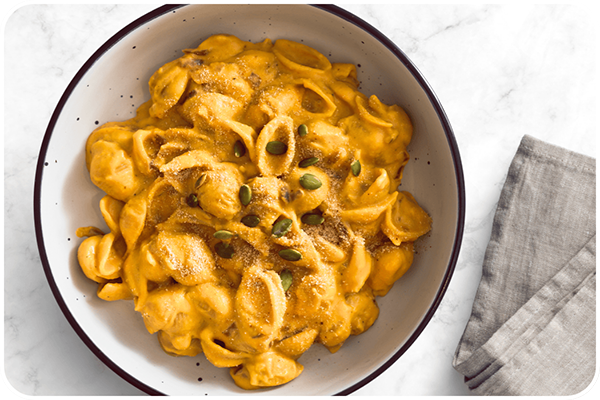
Ingredients
- 12 to 16 oz pasta
- 15 oz can of pureed pumpkin
- 1/2 tsp garlic powder
- 1/2 tsp salt
- 2 tbsp olive oil
- 1 cup of unsweetened soymilk
- 1 cup of nutritional yeast or vegan cheese
Instructions
- Cook the pasta, cool, and set aside.
- Mix the remaining ingredients in a pot on medium heat, stirring constantly, until blended (about 5 minutes).
- Add sauce to the pasta.
- Sprinkle with ground pepper before eating.
Omega-3s
Omega-3 fats are important for the long-term health of the heart and brain, but are found in a limited number of plant foods. Walnuts, canola oil, flaxseeds and flaxseed oil, chia seeds, hemp seeds, and perilla oil are high in the omega-3, alpha-linolenic acid (ALA). There are two other omega-3s, EPA and DHA, which our bodies make from ALA and are also found in fatty fish. While I don’t think there’s sufficient evidence to suggest vegans require a dietary source of EPA or DHA, vegan supplements made from algae are available.
Chia Seed Pudding Recipe
A delicious way to get your daily omega-3s is from chia seed pudding, which you can eat for breakfast or as a dessert.
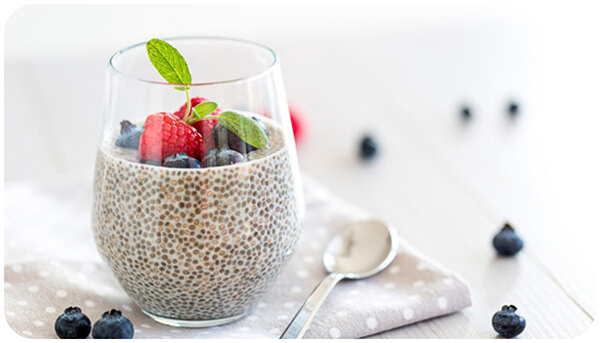
Ingredients
- 1-3/4 cups of unsweetened plant milk (or sweetened plant milk and omit the sweetener ingredient below)
- 1 to 2 tablespoons of sweetener (for example, sugar or maple syrup)
- 1/2 cup of chia seeds
- 1/2 to 1 teaspoon of vanilla extract (optional)
Instructions
- In a bowl, whisk together the ingredients.
- Chill for a few hours and stir before eating.
- Even better served with toppings, such as fruit, peanut butter, or chocolate chips.
- Keep refrigerated.
Another option is to keep a jar of hemp or ground flaxseeds in the refrigerator to sprinkle them on meals throughout the day—they’re easy to incorporate into anything you’re eating.
Nutrients Most Easily Obtained from Supplements
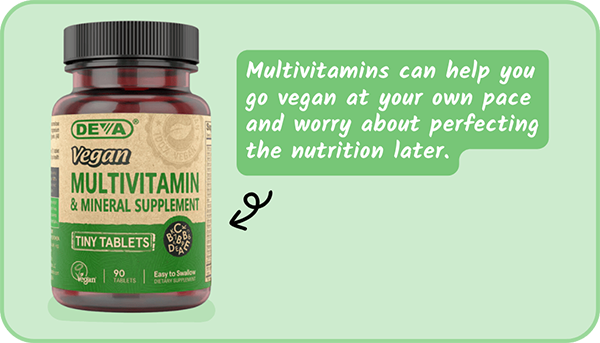
Nutrient deficiencies won’t occur in only a few weeks or even months of being vegan. That’s good news because it means you can go vegan at your own pace and worry about perfecting the nutrition later. In the long term, to be a thriving vegan, you’ll want to make sure you obtain a reliable source of vitamin B12, iodine, selenium, vitamin D, and in some cases zinc.
- Vitamin B12 in vegan diets has been a source of controversy and myths. Plant foods don’t contain vitamin B12 unless fortified. If you don’t get a reliable source, the chances are high that you’ll eventually develop fatigue or tingling in your fingers or toes. On the other hand, vegans who obtain a reliable source of vitamin B12 can have healthier levels than nonvegans. Additional info on vitamin B12.
- Iodine is important for a healthy thyroid. Iodine is found inconsistently in plant foods depending on the iodine content of the soil. The soil in many countries is low in iodine and so iodine has been added to some brands of table salt. You should make sure you have a source of iodine either from iodized salt or a supplement containing potassium iodide. For supplements, if convenient choose potassium iodide over kelp. Additional info on iodine.
- Selenium is lacking in the soil in many countries and so a multivitamin with selenium is the most reliable source. Soil in the United States and Canada has enough selenium for vegans there not to be concerned. Additional info on selenium.
- Vitamin D deficiency can result in fatigue and muscle and bone pain. Vitamin D can be created by skin exposure to sunshine (10-15 minutes for people with light skin, 20 minutes for people with dark skin, 30 minutes for seniors) when the sun is direct enough to cause sunburn. But to avoid skin cancer, dermatologists recommend obtaining vitamin D from supplements rather than sunshine. The dietary reference intake (DRI) for most age groups is 600 IU per day. Additional info on vitamin D.
- Zinc intakes from food are usually adequate for most vegans, but some vegans might fall a bit short. Symptoms of zinc deficiency include catching frequent colds or developing cracks at the corners of your mouth. Additional info on zinc.
Supplement Recommendations
We recommend that vegans take a daily multivitamin that contains the amounts of nutrients listed in the table below. These amounts are not the recommended daily allowances (RDAs), but rather the amounts that will meet the needs of vegans after taking into account what vegans typically obtain through foods.
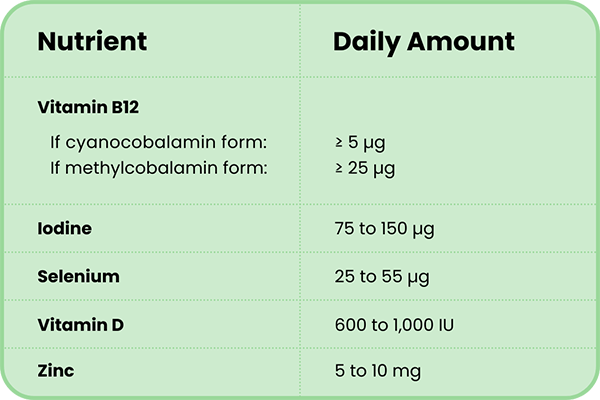
Good options for meeting these requirements are:
- Australia: One tablet of the DEVA Vegan Multivitamin Tiny Tablets contains 6 µg of B12, 75 µg of iodine, 800 IU of vitamin D, 5 mg of zinc, and 36 µg of selenium.
- Canada: One tablet of the DEVA Vegan Multivitamin and Mineral Support contains 6 µg of B12, 75 µg of iodine, 400 IU of vitamin D, 5 mg of zinc, and 36 µg of selenium.
- Kenya: One tablet of the Holland and Barrett Vegan Multivitamin and Mineral contains 10 µg of B12, 150 µg of iodine, 400 IU of vitamin D, 10 mg of zinc, and 55 µg of selenium.
- New Zealand: One tablet of the Holland and Barrett Vegan Multivitamin and Mineral contains 10 µg of B12, 150 µg of iodine, 400 IU of vitamin D, 10 mg of zinc, and 55 µg of selenium.
- Phillippines: Two tablets of the Herbs and Earth MultiVeg Vegan Multivitamins contain 67 µg of B12, 267 IU of vitamin D, 10 mg of zinc, 33 µg of selenium, and kelp for iodine (it’s not clear how much but given that the Philippines is close to water, the food supply should contain enough iodine to make up the rest).
- Singapore: One tablet of the DEVA Multivitamin and Mineral Supplement contains 6 µg of B12, 75 µg of iodine, 800 IU of vitamin D, 5 mg of zinc, and 36 µg of selenium.
- South Africa: One tablet of the Viridian Essential Vegan Multi contains 500 µg of B12, 150 µg of iodine, 400 IU of vitamin D, 10 mg of zinc, and 50 µg of selenium.
- United Kingdom: One tablet of the VEG 1 Blackcurrant contains 25 µg of B12, 150 µg of iodine, 800 IU of vitamin D, and 60 µg of selenium. For an option with zinc, one tablet of Holland and Barrett ABC-Z Multivits and Minerals High Strength Vegan contains 10 µg of B12, 150 µg of iodine, 1,000 IU of vitamin D, 10 mg of zinc, and 55 µg of selenium.
- United States: One tablet of the DEVA Tiny Tablets contains 6 µg of B12, 75 µg of iodine, 800 IU of vitamin D, 5 mg of zinc, and 36 µg of selenium.
Other Versions of this Article
- Albania: Këshilla të të Ushqyerit për Veganët
- Argentina: Consejos para personas veganas
- Austria: Ernährungstipps für VeganerInnen
- Bangladesh: ভিগানদের জন্য পুষ্টিবিষয়ক তথ্য
- Belarus: Советы по питанию для веганов
- Bolivia: Consejos para personas veganas
- Brazil: Dicas de Nutrição para Pessoas Veganas
- Bulgaria: Съвети за Хранене за Вегани
- Chile: Consejos para personas veganas
- Colombia: Consejos para personas veganas
- Costa Rica: Consejos para personas veganas
- Croatia: Nutritivni saveti za vegane
- Czech Republic: Výživové tipy pro vegany
- Dominican Republic: Consejos para personas veganas
- Ecuador: Consejos para personas veganas
- Egypt: نصائح غذائية للنباتيين
- Estonia: Toitumisnõuanded veganitele
- France: Conseils nutritionnels pour végétaliens
- Germany: Ernährungstipps für VeganerInnen
- Greece: Διατροφικές συμβουλές για βίγκαν
- Hungary: Táplálkozási Tanácsok Vegánoknak
- India: Nutrition Tips for Vegans
- Indonesia: Tips Nutrisi untuk para Vegan
- Ireland: Nutrition Tips for Vegans
- Italy: Consigli nutrizionali per vegani
- Japan: ヴィーガンのための栄養ガイド
- Kosovo: Këshilla të të Ushqyerit për Veganët
- Malaysia: Tip Nutrisi Buat Vegan
- Mexico: Consejos para personas veganas
- Morocco: نصائح تغذية للنباتيين و النباتيات
- Myanmar: vegan များအတွက် အာဟာရအကြံပြုချက်များ
- Nigeria: Nutrition Tips for Vegans
- Pakistan: ویگنز کے لئے غذائیتی مشورے
- Panama: Consejos para personas veganas
- Peru: Consejos para personas veganas
- Poland: Wskazówki żywieniowe dla wegan
- Portugal: Dicas de Nutrição para Veganos
- Puerto Rico: Consejos para personas veganas
- Romania: Informații despre nutriție pentru vegani
- Russia: Советы по питанию для веганов
- Serbia: Nutritivni saveti za vegane
- South Korea: 비건을 위한 영양팁
- Spain: Consejos para personas veganas
- Sweden: Näringstips för veganer
- Switzerland: Ernährungstipps für VeganerInnen
- Taiwan: Vegan全植物飲食的營養秘訣
- Thailand: เคล็ดลับโภชนาการสำหรับคนทานวีแกน
- Turkey: Veganlar için Beslenme Önerileri
- Ukraine: Поради щодо харчування для веганів
- Vietnam: Thông tin dinh dưỡng cho người ăn thuần chay
62 thoughts on “Nutrition Tips for Vegans”
I’m worried about getting enough protein. I weigh 190 lb and I’m fairly active. I’m 67 years of age. I never feel like I can eat enough protein. I think I need somewhere around 80 g a day and it’s hard to get on a vegan diet. Can you help me
Michael,
About 80 g per day is right. Here’s a list of vegan foods and protein amounts. Firm tofu and seitan are the highest per serving. Other foods throughout the day will add up. Have you tried logging your foods for a few days to see where you come out? Many people use Cronometer. There’s also protein powder. Orgain is 21 g per serving (2 scoops).
I have diverticulitis and considering going vegan. I have to watch my fiber intake which exists in a lot of plants. Is there special way to balance this?
Robert,
Here’s an article that might be helpful:
https://www.hopkinsmedicine.org/health/expert-qa/foods-for-diverticulosis-and-diverticulitis
Hi Jack,
I’m curious what you think about nutritional yeast flakes as a supplement in a vegan diet. I’m not referring to vitamin B12 here, which is often mentioned in the context of nutritional yeast (as we know, for it to contain B12 it must be fortified). I mean the rest of the vitamins.
According to USDA data*, just a few grams of flakes contain huge amounts of various B vitamins. For example, 3 teaspoons of flakes provide as much as 830% of the RDA for vitamin B1, 780% for vitamin B2, 360% for vitamin B3, and 680% for vitamin B6.
It therefore seems that a small amount of flakes daily can do wonders. This is especially useful for vitamin B2, which can be problematic in a vegan diet.
However, I’m worried whether there might be a risk of overdoing it. For example, the lowest UL for vitamin B3 is 20 mg. So could we potentially reach harmful excess levels of certain vitamins through nutritional yeast?
How many grams of nutritional yeast would you recommend as a maximum per day?
*https://fdc.nal.usda.gov/food-details/1744022/nutrients
Bazyliszek
Here’s what the Office of Dietary Supplements says about excessive niacin: https://ods.od.nih.gov/factsheets/Niacin-HealthProfessional/#h16
It seems to me that even a few tablespoons of fortified nutritional yeast per day is safe for adults. But someone taking that much should be aware of flushing, which is defined at the ODS link above.
This is the type of food that I have I have dates figs kiwi pears apples oranges raspberries blackberries blueberries strawberries pineapple dragon fruit raisins purple cabbage white cabbage kale spinach garbanzo beans black beans pinto beans oatmeal delicious blend of heritage flakes cereal coconut milk flaxseed milk coconut water purified water red bell peppers green bell peppers yellow bell peppers orange bell peppers cauliflower okra sweet potatoes white potato collard greens, turnip greens walnuts almonds cashews butternut squash zucchini cucumbers carrots purple onion yellow onions I just like to know how to cook this stuff as a vegan if I could be helped with recipes with the food I already have I would greatly appreciate it thank you
Tammie,
Check out our recipe generator.
I am celiac. I require 1/3 more protein than other people because my body uses extra energy to digest food. Do you have recommendations for how to easily attain this goal?
Lisa,
Eating more soy would be the easiest way: tofu, tempeh, soy meats. And other legumes. We list them at the top of this page under Protein.
I’m Prashant 25 years old my hight is 5.7 inches, skinny and I wanted to gain my weight with vegan food as a healthy person.
I have stoped to eat meat and dairy products since 3 months and I don’t eat sugar too.
So can you please give me a nutritional diet chart for two meals a day to help my physicality and support good health.
Prashant,
A skinny person isn’t likely to ever become not skinny in the sense that skinniness is largely determined by the bone structure. A skinny person can usually gain fat simply by eating more, and gain muscle by lifting weights and making sure they get enough protein (by following the guidelines for protein above). You might try the Strongr Fastr site for high-protein vegan meal plans.
Will my triglycerides go down with a vegetarian/vegan diet?
Jan,
Observational studies show that, on average, vegans have lower triglycerides than people in other diet groups. I’ve never compiled a list of clinical trials to analyze what happens to people’s triglycerides when they’re put on a vegan diet so, due to time constraints, I asked the AI chatbot, Juma, to review the studies and the following is what it said which seems like an accurate representation of the research as I understand it:
> Do RCTs putting people on a vegan diet find triglycerides go down? Generally no—most show neutral or small increases unless the diet emphasizes whole carbohydrates, weight loss occurs, and alcohol/refined carbs are limited. They do, however, reliably reduce LDL and total cholesterol.
> If the goal is lowering triglycerides on a vegan diet, here’s how we can stack the odds in our favor:
> Emphasize whole, low‑glycemic carbs (intact grains, legumes, vegetables, whole fruit); limit refined starches/sugars and ultra‑processed foods.
> Include plant omega‑3s (flax/chia/walnuts/camelina); consider an algal EPA/DHA supplement if TGs are elevated.
> Keep alcohol modest; it can raise TGs.
> Maintain an energy deficit if weight loss is indicated; even 5–10% loss helps TGs.
> Consider a modestly higher‑fat, unsaturated‑fat–forward vegan pattern (nuts, seeds, olives, avocado, tofu/tempeh) rather than very‑low‑fat if TGs run high.
> Stay active; exercise lowers TGs.
Can someone who is allergic to beans, lentils, peas and nuts/peanuts still eat a vegan diet? (Would they still be able to have enough plants based protein options?)
Dee,
These articles on food allergies might be helpful.
Howcan i get my right nutrients that i need a day what fo i need to eat other then soy and wheat
Shirley,
This article explains how to get the nutrients you need. While soy can make it easier to get protein, there are plenty of other sources, as listed in the article.
I am a non vegetarian. I want to replace eggs meats for various nutritions like omega 3, protein etc. from childhood inam drinking milk and I want to replace it and still grow my height and make bones stronger. the cakes containing cakes are my favourite I want to replace something with egg and get the exact texture. I just want to be vegan but don’t want to feel the emptiness of animal products.
Bidisha,
What country do you live in and how old are you?
Hi Jack,
What is your opinion on the Naturelo One Daily Vegan Men’s and Women’s Multivitamins? Seems like they unfortunately use kelp instead of potassium iodide and methylcobalamin instead of cyanocobalamin (and a lower methylcobalamin dose than recommended). I’m wondering if otherwise, they’re still a decent multivitamin? I’ve been using them and supplementing with 2000 mcg of cyanocobalamin sublingual 1x per week, but curious as to your thoughts. I can get the Deva, but Naturelo is on Amazon so slightly more convenient.
Thank you!
Links:
https://naturelo.com/products/one-daily-multivitamin-men
https://naturelo.com/products/one-daily-multivitamin-women
Lora,
Other than what you mention, the Naturelo seems fine to me. It’s a bit high in vitamin B3, about half the Tolerable Upper Intake Level, but as long as someone only takes one per day, without any other source of supplemental B3, that should be okay.
I found this article on VeganHealth.org to be exceptionally insightful: it offers a clear, evidence‑based guide to critical nutrients for new vegans. I learned a great deal about how to obtain calcium, omega‑3s, and vitamin A from plant-based foods, and I especially appreciated the practical tips and simple recipes (like the pumpkin mac and cheese and chia pudding) that make it easy to apply the information. Moreover, the section on essential nutrients that are harder to get through food alone (such as B12, iodine, selenium, and vitamin D) was particularly enlightening. The balanced approach — emphasizing whole-food sources while acknowledging when supplementation is prudent — reflects a nuanced, responsible perspective. Overall, this is incredibly informative, and I feel much more confident in planning a nutritionally sound vegan diet after reading it.
Hi!
It’s me again, the same guy that commented in your post “B12 in plant foods” about Sea Buckthorn some days ago. Thanks for the detailed response! I’ve been investigating a bit more and I’ve realised that, at the current time and probably in years or decades to come, there isn’t a reasonably reliable natural vegan B12 source, that’s why I’ll keep taking supplements. Right now I’m taking a multi and B12 separetely because the multi has methylcobalamin, but I want to take just one supplement in the future for convenience. I found this other multi that has 50 micrograms of cianocobalamin and 100% of the RDA of iodine, selenium, zinc and vit D: https://www.weightworld.es/multivitaminas-minerales-400-comprimidos.html I don’t know if it’s available in other countries appart from Spain, but the one that is recommended in the Spanish version of this article has 10 micrograms of methylcobalamin only and I’m not sure about the rest of nutrients, so maybe this one is better.
Lastly, I was wondering wether you could make a post (or have one) or give me a brief summary about what vitamins and minerals (in certain amounts) generally shouldn’t be included in a multi, wether it is because of high concentrations having adverse effects, because some are better taken separately, etc.
Victor,
Unfortunately, the vitamin D in the WeightWorld isn’t vegan. Other than that, yes, it’s a better multivitamin for B12, iodine (because it contains potassium iodide rather than iodine from kelp), and zinc (10 mg rather than 5 mg). In some cases, where a vegan version of vitamin D isn’t available in a country, we recommend a multi that’s vegan except for the vitamin D. However, since there’s an option in Spain, we stick with the vegan version. If I found out a vegan was taking the WeightWorld version, I wouldn’t be upset—people being 99.9% vegan is good enough for me, and I don’t want someone quitting because the final .1% was too much hassle.
I don’t have a well-researched answer for you regarding your question about what should not be included in a multivitamin. For me to review every vitamin and mineral to determine what’s too much would take a long time. It’s probably best to conduct an internet search for any nutrient you’re concerned about. Most supplement companies avoid overloading their products with any single nutrient.
Oh, what a bummer :(. Are you sure about the D3 in their multi not being vegan? Because they have an only D3 suplement wich is clearly labeled as vegetarian (therefore made with lanonin) https://www.weightworld.es/vitamina-d3-4000ui.html but then they have a D3+K2 which is labeled as vegan https://www.weightworld.es/vitamina-d3-y-k2-4000ui-125-mcg.html, and the multi I recommended is labeled as vegan too https://www.weightworld.es/multivitaminas-minerales-400-comprimidos.html (alought in the web they have tagged it as vegetarian, the product itself and it’s description is labeled as vegan). I’ll ask the brand just to make sure 🙂
Victor,
I apologize, it does appear to be vegan. I didn’t notice anything on the very front of the label saying vegan, and not being a Spanish speaker, I didn’t search all their panels, I just assumed the vitamin D3 must not be. But, now that I’ve gone through it more thoroughly, they clearly claim it’s vegan. Sorry about that! I’ll replace or add it to the list of multis.
It would be nice to see choline mentioned here. If a person is eating fewer calories than average, and/or relying heavily on grains (because of cost for example), then it would be possible for a vegan to end up with less than the minimum of 250-300mg choline per day to decrease risk of Alzheimer’s and other dementia. Soy lecithin or lecithin granules can provide some choline. Beans have some but possibly not enough. Some vegetables are good sources but because of cost, convenience, ignorance, or taste (especially not knowing how to prepare them), there are a lot of people who aren’t getting enough of these. It would be practically impossible to get too much, but sadly it could be very easy to not get enough
Erica,
Thank you for reminding vegans about how to get plenty of choline. I’m torn about recommending that vegans pay special attention to choline because I don’t think there’s evidence that vegans, any vegans, have developed clinical signs that could be linked to choline deficiency. I wish it was studied more thoroughly.
For what it’s worth, I once took choline supplements to see if they made any difference in my perceived cognition or feelings of wellness and they didn’t.
I’ve been checking the website a few times over the years but it seems the Vegetology Multi Vit multi vitamin (the multi vitamin recommendation for Australia) has been closed since around 2020, Do you know of any alternatives that are sold in Australia?
Max,
Sorry about that. I’ve replaced the link to the Vegetology multivitamin with a link to a DEVA vegan multivitamin: One tablet of the DEVA Vegan Multivitamin Tiny Tablets contains 6 µg of B12, 75 µg of iodine, 800 IU of vitamin D, 5 mg of zinc, and 36 µg of selenium.
Hi Jack, the question: you recommend here 25 mcg of methylcobalamin daily, is there any comprehensive update on this? As here https://veganhealth.org/vitamin-b12/methylcobalamin-and-adenosylcobalamin/ it is still 1000 mcg daily at least. My personal experience is that 1000 + 1000 mcg of methylcobalamin per week has been working for 9 years, maybe due to some beneficial folat cycle DNA specifics I have (just speculating, no time to genetic tests).
Mykyta,
The most unfortunate trend among supplement companies to replace cyanocobalamin with methylcobalamin has necessitated that we recommend multivitamins in some countries that contain methylcobalamin. I settled on 25 µg as merely the best I think we can do at this time, mostly based on the 1971 study on absorption.
Hi. I have been vegetarian (though almost vegan and only almost vegan for reasons mostly outside of my control) since the begining of 2024. I was taking supliments for like 5 months every morning but the habit slowly faded and I realised I actually feel a bit better not taking supliments and now I am very certain that somehow, for some reason, my multivitamin makes it easier for me to catch a headache, like for example if I lean my head on a wall without a pillow, that could be enough to cause a headache if I do it for long enough (which would probobly be 10 minutes or less) and I also noticed that I haven’t been sick as often and I don’t get a sore throat nearly as often (which is almost always my first symptom of what develops into a cold). Could this be due to me getting too much of a certain mineral or vitamin or could it be something else? I’ve felt in tip-top shape since I stopped taking supliments but I worry that I am or will be deffecient in vitamin B12 or some other vitamins or minerals. I know that as a vegan, I must supplement, but what is the matter if they are making me sick?
Denis,
Sensitivity to something in your multivitamin doesn’t seem outside the realm of possibility. Most of these nutrients can be obtained in ways other than through supplements. If you click on the link to more information at the end of each nutrient’s section, you’ll be taken to a page that provides alternative ways for obtaining the nutrients.
Good luck!
Is there a reason why for your US multivitamin recommendation, you linked to the version of the DEVA Tiny Tablets with iron included instead of the iron-free version?
Dylan,
I don’t recall my exact thought process at the time, but in retrospect, I don’t think there’s any problem with including iron and it might slightly benefit some people. One exception would be for people with hemachromatosis, but they already know to avoid supplements with iron.
Hey so you list some multivitamins in the end and I was really excited about that until I realized you didn’t include calcium in your list. Can you perhaps edit the article to include some supplements which deviate a little from your listed recommended multivitamin nutrients. I’ve been looking for a supplement with the exact things you listed, except I need calcium and preferably vitamin A as well (preferably in the form of beta-carotene).
Noam,
Multivitamins don’t contain enough calcium to make them a good source. The volume of calcium would be too much to fit in one tablet with the rest of the nutrients. So you need to get calcium from a different source as I describe above. Most multis have vitamin A, including the ones I recommend below.
So i previously commented about this, but the comment is gone now it seems… anyway, shortly after going vegan i had skin rashes, acne and so on. I figure its related to a multi i was using having 25ug of B12 and 30 mg of niacin – ive read both can cause skin breakouts? I later switched to a multi with 15ug of b12 (which i was taking near daily, sometimes i would forget) and this seemed to help but not eliminate the issue. should i try an even lower amount of b12 supplementation or b12 injections?
Pepo,
I emailed you using the email you submitted with your comment. I had follow-up questions and didn’t want to discuss it through the website. See if you got the email.
Hi. I live in eastern europe and have so far been using a multivitamin, that does meet your reccommendations. But it does also have iron, calcium and zinc, much like your recommended DEVA multis. I have heard that consuming iron and calcium at once may not be ideal and may inhibit absorption of both. Is this true (it seemed to me like research about this was quite lacking) and it is a concern? i really cant afford buying supplements seperately. Thanks.
The amount of calcium in a multivitamin isn’t anything to worry about with regard to iron. A multivitamin shouldn’t be relied on for iron. The most important thing for increasing iron absorption is to add vitamin C (mentioned above in this article) and avoid tea and coffee at meals. If you have diagnosed iron deficiency then you should probably be taking an iron supplement under the guidance of a physician.
You recommend a multivitamin based off of what is typically present in a vegan diet. I have heard elsewhere that supplementing individual nutrients is preferable to a multivitamin both so you can spread out when your body needs to absorb nutrients and so that you can personalize supplementation more and don’t get too much of certain nutrients. Aside from time, is there a downside to supplementing individual nutrients? Are you likely to get too many of certain nutrients from the multivitamins (specifically the DEVA tiny tablet) recommended here? How likely is a vegan to be nutrient deficient in something even while taking one of these multivitamins?
> Aside from time, is there a downside to supplementing individual nutrients?
Possibly money, but otherwise no.
> Are you likely to get too many of certain nutrients from the multivitamins (specifically the DEVA tiny tablet) recommended here?
No.
> How likely is a vegan to be nutrient deficient in something even while taking one of these multivitamins?
Very unlikely as long as they follow the other recommendations for protein, iron, calcium, vitamin A, and omega-3s.
Hello, thank you for pointing out that iron from plants is less easily absorbed than the iron from animals. Personally, I’ve found that your recommendation to get plenty of vitamin C, both through supplements and through foods (and I do do both), is very helpful for iron absorption and for other reasons, too.
While I wholeheartedly agree with you that iron deficiency can be a problem for women, I’m inclined to believe that it can be a problem for men, too. If a man is craving pizza (peperoni, tomatoes) or meat-based burgers, or liver (lots of iron there), my first thought would be that he may want to check his iron levels.
Men can be deficient in iron, too.
It’s a sad thing when someone gives up on plant-based because they can’t figure out why they’re not feeling their best; the information you provide here is so valuable!
What if I don’t like beans
Hi Anita – There are other legumes (peanuts, peas, lentils, soy foods such as tofu and tempeh, and vegan meats made from peas and soy) and other vegan foods (seitan, quinoa) that are rich in protein. So, you don’t have to eat beans as a vegan. However, they are super nutritious, affordable and versatile so you might consider trying them in different forms and prepared in different ways (such as refried beans, hummus, bean dip, etc.).
Other ways to eat beans include dosas, handvo, or variations on those, which may be prepared at home by soaking beans (and maybe some grains, too) for several hours or overnight, then turning them into a paste/dough in a food processor, adding a probiotic like the powder from a probiotic capsule as a fermentation starter, then leaving in a warm place for about 4 hours (or more if you like) and then baking or cooking on the stove top as a flatbread. Spices, herbs, vegetables, and other flavorings may be added right before baking.
Hello,
I give my kids algae oil for DHA/EPA. I have been told (on a vegan Facebook page) there are studies that show algae oil and it’s link to MS, ALS and other neuro-degenerative diseases. That algae produces BMAA (BMAA causes protein unfolding in the brain leading to neuro diseases.) and microcystins are in algae oil, which are especially harmful to children. They said it’s not just blue-green algae that is unsafe, It’s with all algae oils and supplements as there is immense opportunity for contamination even if a “safe” species of algae is used – the one we use is Schizochytrium sp.
I’m just trying to find out more information as I’m now worried about using algae oil and I don’t know of any other dietary sources of DHA/EPA?
Here is the study…
https://www.ncbi.nlm.nih.gov/pmc/articles/PMC5371831/
Jodie,
> and it’s link to MS, ALS and other neuro-degenerative diseases.
Are you saying that the study you linked to, Detection of Cyanotoxins in Algae Dietary Supplements, shows this link? That study doesn’t show such a link and while it’s possible I’ve missed it, I’m not aware of any research showing such a link.
However, at VeganHealth.org, we don’t consider DHA or EPA supplements necessary for children, other than for pre-term infants. If parents ensure a regular source of alpha-linolenic acid (see Daily Needs) for kids, they generally shouldn’t need algal oil supplements. If someone prefers that their children have a direct source of DHA and is concerned about contamination, I’d suggest contacting some of the companies (or looking at their websites) to see if they test for toxins to their satisfaction.
I was interested in the comment asking about BMAA and microcystins in algae supplements. According to the abstract Jodie Courtney linked to, the article appeared to be about Spirulina supplements exclusively. Spriulina is a blue-green algae, but unlike some other blue-green algae, it is not toxic. It seems like the problem is that the Spirulina algae, when grown in wild, natural environments, may become intermixed with other wild, toxic blue-green algae. The abstract said, in part, “These products generally contain non-toxic cyanobacteria, but the methods of cultivation in natural waters without appropriate quality controls allow contamination by toxin producer species present in the natural environment.” My understanding of the abstract is that Spriulina is a blue-green algae and when grown in open natural environments, the product may become contaminated with other, unsafe blue-green algae.
On the other hand, it is my understanding that Schizochytrium grown for harvesting its high-DHA oil is grown in a highly controlled environment in steel tanks. I have not seen any company claiming to grow Schizochytrium in any other way.
I don’t know why someone on the Facebook group would make a link between a blue-green algae grown in a wild environment and a Schizochytrium algae species grown in a highly controlled environment.
BMAA stands for beta-N-methlamino-l-alanine. I tried to search for this term along with Schizochytrium, but the results that came up were all about BMAA in blue-green algae exclusively. It appears to me that BMAA and microcystins occur in blue-green algae, and when contamination occurs, it is because of the presence of these toxic algae. I would think that if a manufacturer took measures to avoid this contamination, the toxins would not be present?
I am new to the vegan diet and am concerned about the anti nutrients found in vegetables, legumes, grains and nuts. I don’t know the best resource that addresses this issue that can allay my fears with embarking on this way of eating. Can you advise?
Hi Susan – As long as you’re following the recommendations on our Daily Needs page, you shouldn’t need to worry about so-called “anti nutrients.” We have an article on oxalate and you can find info about phytate in our iron article and zinc article
I have the old edition of Vegan for Life and I’ve just noticed that there’s a new (2020) one – is there much difference between the two? I’m not sure whether to buy the new one.
Gill,
We added a lot of information to the new edition so you might want to compare the table of contents to see if any of the new information interests you. There wasn’t anything in the old edition that I would consider so outdated that it would make a difference to your health if you continue to follow it, but we tweaked a few things for the second edition.
I was told to take fish oil for brain health and would like to find a good, organic vegan alternative. Can you help?
Hi Deborah,
You can find dietary supplements with algae-derived EPA and DHA. Make sure the capsule is not gelatin as that is not vegan.
What about the issue of having too low HDL cholesterol? Will olive oil or another fat help with this?
Brian,
You should talk to your doctor about whether your personal HDL levels are of concern and what to do with respect to them, but in general people should focus on eating a well-balanced diet as shown in the Plant Plate (theveganrd.com/vegan-nutrition-101/food-guide-for-vegans/) and exercising, but not purposefully adding extra oils or fats in order to raise HDL levels.
And where are the article about cats vegan diet at the new version of site? )’: It’s very usefull and I recommend it to other(((
Sorry for offtop.
https://veganoutreach.org/category/companion-animals/